

The Most Compelling Part of a Grant Proposal:
How to Make Realistic Project Goals in Grant Applications
Taylor Paiz | February 25, 2026
All funding proposals require clear goals and a project evaluation plan. It is arguably the most important section for developing a competitive application. Not all projects lend themselves to quantitative measurement, and developing evaluation plans for these projects can be especially challenging. Nevertheless, a strong plan is crucial for securing competitive funding.
In this article, we’ll discuss why evaluation plans are so important, why they must include measurable components, and how to develop a plan with realistic goals if you’re just getting started.
Why Are Evaluation Plans So Important?
An evaluation plan is a tool for effectively translating and verifying a project’s impact. Your project goals tell funders what you aim to accomplish. The evaluation plan demonstrates how realistic those goals are and whether you have a viable strategy to reach them. Measurable evaluation plans provide a reliable, objective framework for holding programs and teams accountable to achieving results and for verifying that invested funds are utilized as intended.
However, project teams aren’t the only ones accountable for outcomes. Funders have goals and objectives of their own. Like project teams, grantmakers must report on the results of their investments and clearly demonstrate the benefits of funding specific projects. Foundations typically report to a board of directors or investors, while federal agencies must justify the value of funded projects to the public.
Grantmakers rely on your project’s goals and outcomes to assess and communicate their own impact. Because of this, the clarity with which you communicate measurable impact and the strength of your evaluation plan are directly linked to the competitiveness of your proposal.
Challenges to Communicating Impact
Throughout my career, I have been continually surprised by how many organizations struggle to define the impact of their projects through measurable objectives, outcomes, or outputs. This challenge persists even in well-conceived projects, with a qualified team, an execution plan, and ample resources.
So, what is the issue? The challenge is typically one of two things:
1. A formal evaluation plan has not been established or documented:
Project leaders know what the impact of their project should look like. They understand because they work in that industry as subject matter experts; they live in the community; they interact with the people or the product every day.
However, if an evaluation plan has not been documented, it has not been fully defined. If you are documenting the project evaluation plan for the first time in a grant application, it is too late.
Competitive funding proposals typically have extremely short application windows, some only 30-45 days (including weekends). Strong evaluation plans are grounded in data, whether qualitative or quantitative, that can be tracked, collected, aggregated, and analyzed. Every data point requires clarity on the what, how, when, where, and who is involved. It takes time to identify and confirm all the necessary variables for executing an evaluation plan, so it’s important to start early.
2. The data is difficult to track or collect, making the impact difficult to communicate:
Certain types of data can be particularly challenging to track or organize. Some projects are highly complex, requiring a long runway to track and measure progress or involving high levels of confidentiality.
No evaluation plan is flawless, but there is always something you can measure and link to your project's impact. The real challenge lies in identifying which aspects of your program can be tracked in a meaningful way.
Building an Evaluation Plan
Before you can develop an effective evaluation plan, you must define realistic goals for your project and assess the company's resources and capabilities for managing data. Start brainstorming and consider the following questions:
Step 1: Determine the goal(s) of your project.
-
-
What are you trying to accomplish?
-
What are the benefits of the project?
-
Who will your project benefit?
-
What does success look like?
-
What does progress or improvement look like?
-
Step 2: Define success.
-
-
How will you know when you’ve reached your goal(s)?
-
What is the evidence that the project is complete?
-
What products will your project produce?
-
What changes do you expect to see as a result of the project?
-
What is the timeline? How long will it take to accomplish each goal? What milestones can you establish along the way to capture progress?
-
Step 3: Determine what data you can collect.
-
-
How can you verify that the change you expect to see has been accomplished?
-
What type of data does the organization already collect? Can any of that data be used to further communicate impact?
-
Can you collect data from partners?
-
Can you put measures in place to evaluate a change in cost, quality, or efficiency?
-
Can you pair quantitative data with qualitative data?
-
Can you begin conducting interviews, issuing surveys, or collecting stories?
-
What can you track in a short timeframe (1 year)? What can you collect to showcase long-term change (5-10 years)?
-
Step 4: Establish metrics.
-
-
Define your outputs and outcomes:
-
Outputs: what you produce or do.
-
Outcomes: the change that takes place because of what you did (because of the output).
-
-
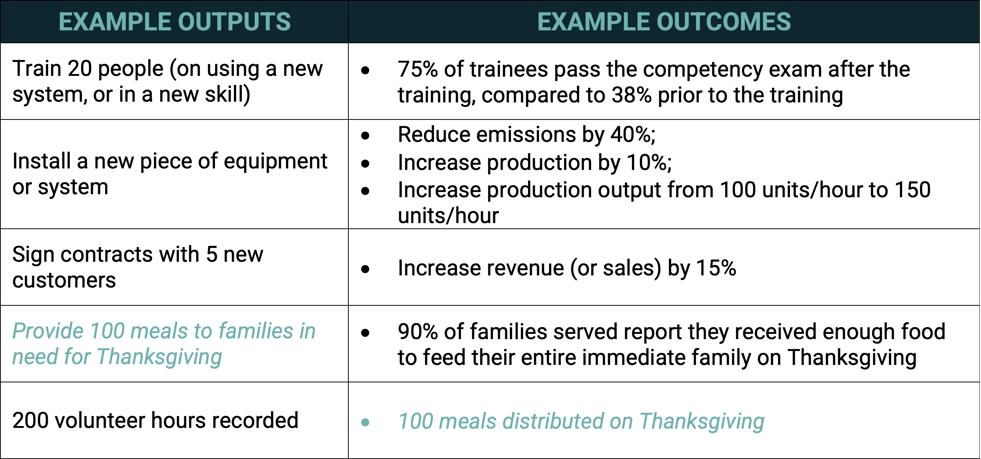
Notice that some data can serve both roles, as illustrated in the table below. The key factor is the cause-and-effect relationship between data points.
-
For example, if you have [x number] of volunteers (output), then you can distribute [x number of meals] (outcome).
-
Or, if you distribute [x number of meals] (output), then [x% of families] report how they were impacted (outcome).
-
-
Step 5: Document an evaluation framework.
-
-
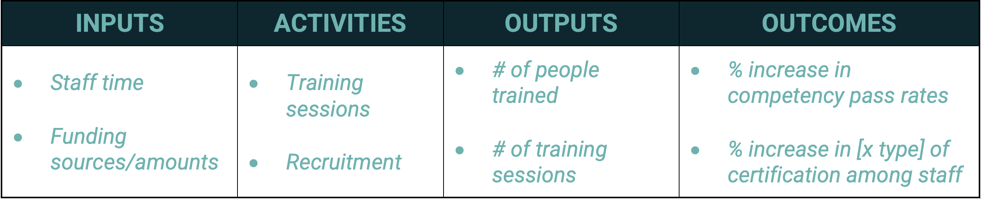
Logic models are commonly requested in grant applications to capture and communicate a project evaluation plan, especially in economic development applications.
-
Even when a logic model isn’t required, having one prepared allows you to quickly and confidently address almost any question about your project’s goals or your approach to evaluating success.
-
-
-
Logic models come in various formats. Start with a simple template like the table below:
-
Conclusion
A strong evaluation plan with clear, measurable goals is essential to win competitive funding. Evaluation plans not only hold project teams accountable for delivering results but also enable funders to report on the impact of their investments. Start by defining realistic goals for your organization and determining what data you can reliably track to measure progress toward those goals.
Just getting started? Check out this insight for more guidance on creating specific, measurable goals.